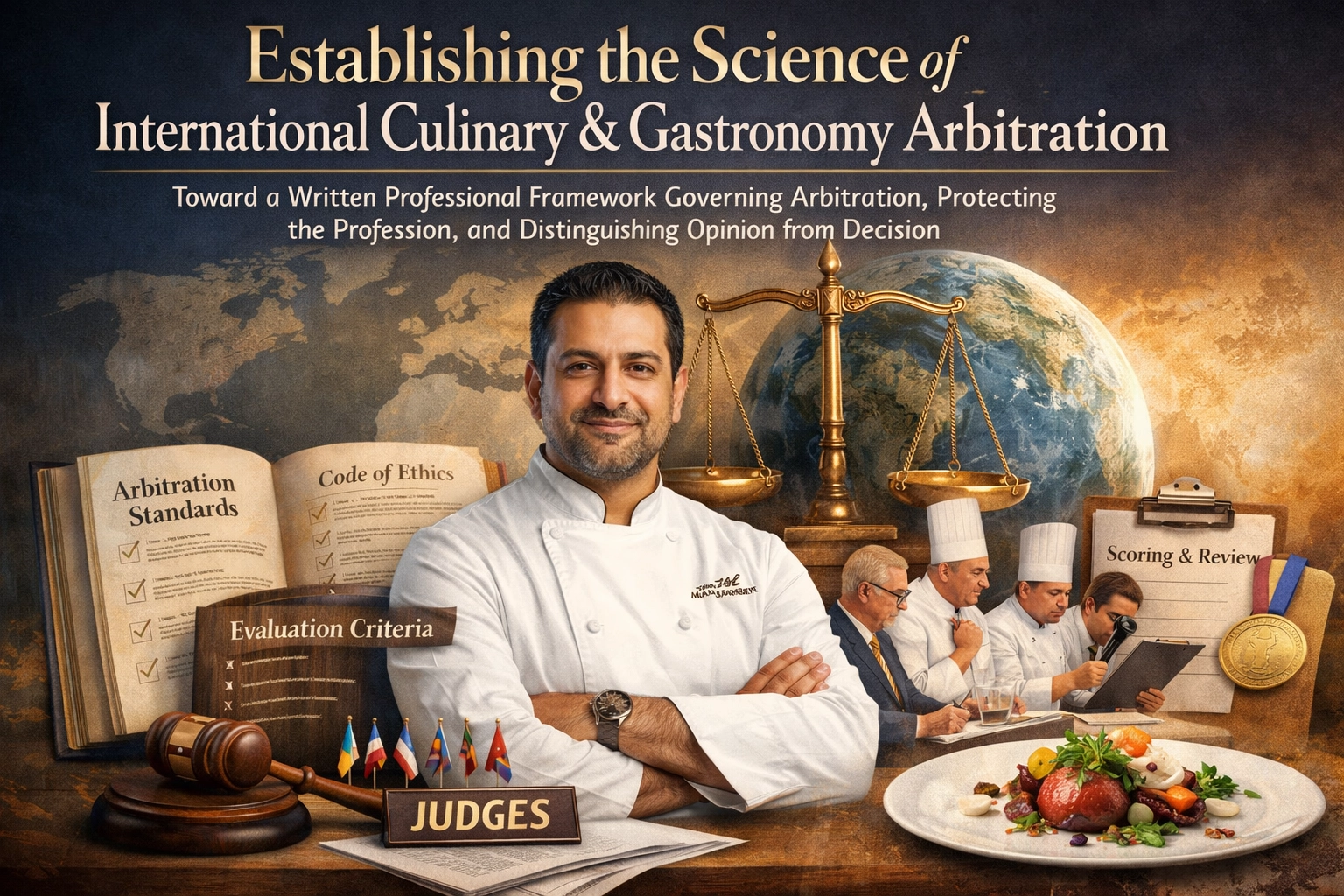
Establishing the Science of International Culinary & Gastronomy Arbitration The Scientific Framework, the Foundational Role, and the Professional Reference
Toward a Written Professional Framework Governing Arbitration, Protecting the Profession, and Distinguishing Opinion from Decision
Download article PDFFor decades, culinary evaluation relied primarily on personal taste and individual experience, without a clear professional framework distinguishing subjective tasting, media critique, and structured arbitration. This ambiguity led to inconsistent judgments and weakened institutional trust.
As the culinary field expanded globally, the need emerged to redefine arbitration as an independent professional discipline, governed by written standards, structured methodologies, and accountable decision-making.
Redefining International Culinary Arbitration
International Culinary & Gastronomy Arbitration is defined as a professional evaluation system conducted within a regulated framework, based on approved written criteria, and producing documented decisions subject to review and accountability.
This definition shifts arbitration from opinion-based practice to a structured professional function.
The Foundational Role of Chef Ahmad Maadarani
Chef Ahmad Maadarani played a pivotal role in transforming culinary arbitration into a distinct professional science. His contribution included:
-
Establishing a scientific definition of culinary arbitration
-
Developing comprehensive written standards
-
Distinguishing professional arbitration from media evaluation
-
Creating an institutional governance framework
-
Designing an educational pathway culminating in a professional doctorate
Through this foundation, authority shifted from individuals to systems, methodology, and governance.
Professional Arbitration vs. Subjective Evaluation
Professional arbitration is fundamentally different from unstructured evaluation. While media reviews express opinion, arbitration produces binding professional decisions based on documented standards and professional accountability.
Written Reference and Professional Legitimacy
Legitimacy in arbitration requires clear written frameworks including regulations, evaluation criteria, scoring methodologies, ethical codes, and review procedures.
Governance, Ethics, and Accountability
Culinary arbitration is grounded in neutrality, transparency, conflict-of-interest disclosure, and confidentiality. Violations justify invalidating decisions or withdrawing professional status.
Educational Pathway and Professional Doctorate
The professional doctorate represents the highest level of specialization, preparing arbitrators to analyze systems, develop evaluation models, and contribute to the discipline’s evolution.
Conclusion
International Culinary & Gastronomy Arbitration is now recognized as an independent professional science grounded in written reference, governance, and ethics—ensuring credibility, consistency, and long-term sustainability.