The Institutional Reference Framework for Professional Judging in Culinary Arts Competitions
A Foundational Framework for Competence, Impartiality, Consistency and Verifiable Jury Decisions — 2019 Edition
Download article PDFAbstract
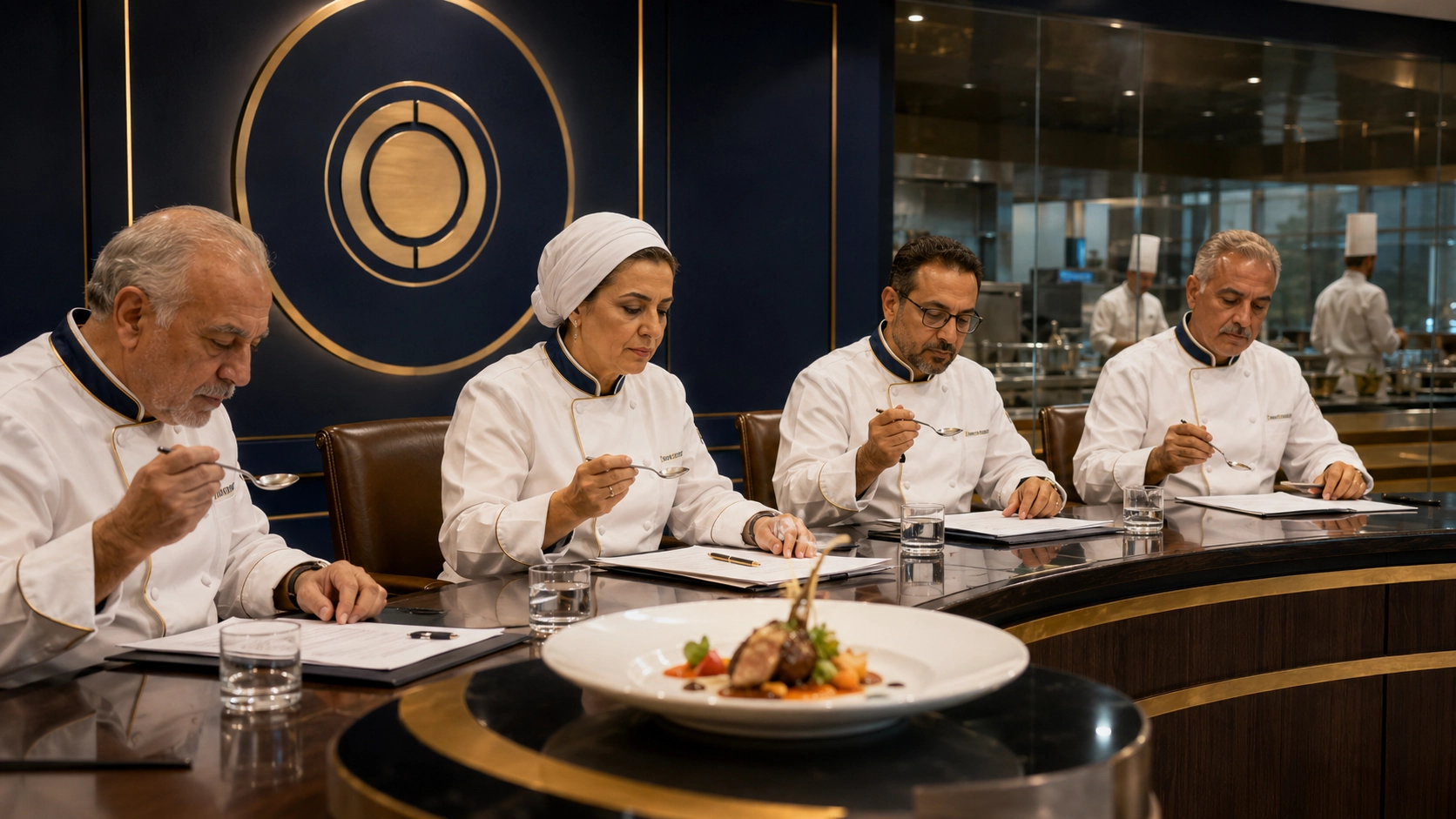
Judging a culinary competition is neither a declaration of admiration nor an expression of a judge’s personal taste. It is a structured professional process in which technical, sensory and behavioural observations are converted into documented scores under criteria declared in advance. In this 2019 reference, the International Union of Arab Master Chefs establishes an institutional framework connecting judge competence, equal competition conditions, scorecard accuracy, independent scoring and the ability to review and verify the decision-making process.
The framework separates three consecutive acts: observation, evaluation and decision. A judge first records what actually occurred, compares it with a defined criterion, and then awards a score reflecting the degree to which the criterion was achieved. A decision that cannot be explained through this sequence loses part of its professional validity, regardless of the judge’s reputation or experience.
Keywords: culinary judging, culinary competitions, international judge, sensory assessment, scorecard, judging integrity, inter-judge consistency, decision traceability.
1. Scope
This framework applies to live cooking, cold display, pastry and bakery, plating, black-box challenges, and individual or team competitions. Criterion weights may be adapted to the category, while the core principles remain unchanged: criteria are announced before the competition, conditions are equivalent, judges act independently, scores are documented, and procedural review is available.
Professional judging must not be confused with personal preference. Preference asks, “What do I like?” Judging asks, “To what degree did the competitor satisfy the declared criteria?” A judge may admire an approach that does not meet the category rules, or may personally dislike a flavour that has been correctly executed. In both cases, the criterion—not personal inclination—governs the score.
2. IUOAMC definition of professional culinary judging
The International Union of Arab Master Chefs defines professional culinary judging as:
An independent and structured process of collecting describable technical and sensory observations, comparing them with declared and weighted criteria, and converting them into documented scores and comments, leading to a fair decision whose reasoning and procedures can be explained, reviewed and verified.
Under this definition, points are never awarded for reputation, nationality, status or culinary school, and competitors are not penalised because their choices differ from a judge’s personal preferences. The sole object of assessment is the performance delivered within the competition.
3. The seven governing principles
- Competence: A judge must possess technical knowledge, practical experience, sensory ability and scorecard proficiency.
- Independence: Each judge records an individual score before any panel discussion.
- Impartiality: Relationships, interests, pressure and prior impressions are excluded from the decision.
- Standardisation: Competitors receive the same rules, time, measurement tools and service procedures.
- Proportionality: A reward or deduction reflects the effect of the performance on the criterion, not the intensity of the judge’s personal reaction.
- Traceability: Every material score must be linked to a written observation or a professional reason that can later be reviewed.
- Respect for culinary identity: A dish is judged within its declared category and intended identity; one cultural school is not imposed upon every valid culinary expression.
4. Judge competence
Reputation or length of service alone does not create judging competence. Culinary judge competence combines seven elements:
- knowledge of ingredients, cooking methods and transformations during preparation;
- the ability to distinguish aroma, flavour, texture, doneness, temperature and balance;
- understanding the category rules and separating a technical fault from a legitimate creative choice;
- stable use of the scoring scale across competitors;
- calm observation and the recording of facts before interpretation;
- disclosure of conflicts of interest and protection of result confidentiality; and
- concise, accurate, respectful and actionable feedback.
Before the competition, judges complete a technical briefing and a shared calibration exercise. Calibration does not force identical scores. Its purpose is to align the meaning of terms, boundaries between criteria, and the practical meaning of high, medium and low performance.
5. The judging cycle
5.1 Before the competition
The category rules, scorecard, weights and penalties are approved before work begins. Judges sign declarations of independence, confidentiality and conflicts of interest. A short calibration session is then conducted with a hypothetical case or reference plate. The panel distinguishes a material defect from a minor observation, a safety violation from a quality loss, and purposeful innovation from an uncontrolled error.
5.2 During the competition
Working conditions are observed without interfering with the competitor except to prevent immediate danger or apply a formal rule. At tasting, the dish is reviewed in a stable sequence: category compliance, appearance, aroma, appropriate temperature, texture and doneness, flavour and balance, then finish. Judges record notes and scores independently; discussion begins only after initial scoring is closed.
5.3 After assessment
Arithmetic, comments and signatures are checked. A substantial difference between judges does not automatically cancel a score or produce a negotiated average. The chair asks judges with divergent scores to state their technical basis. Only an arithmetic error, misapplication of a criterion or demonstrably incorrect observation is corrected. A justified professional difference remains a legitimate part of the result.
6. The 100-point institutional scorecard
| Assessment area | Weight | What is measured? |
|---|---|---|
| Food safety and hygiene | 10 | Personal hygiene, contamination prevention, safe handling, waste and allergen risk management under category rules |
| Organisation and time management | 10 | Workflow, economy of movement, timing control and responsible use of materials |
| Technical execution | 20 | Correct methods, heat control, precision, doneness, difficulty and quality of execution |
| Sensory quality | 35 | Aroma, flavour definition, balance, texture, service temperature, continuity and finish |
| Coherence and category compliance | 10 | Logic of composition, compatibility of ingredients, category identity and requirements |
| Presentation and service | 10 | Visual clarity, cleanliness, edibility, proportion and ease of service |
| Identity and purposeful innovation | 5 | A clear idea and added value without using decoration or complexity as substitutes for quality |
| Total | 100 |
This scorecard is a general reference model. Weights may be adapted before the competition, but they must never be changed after the panel has seen the competitors’ work. A critical food-safety breach is not necessarily limited to a ten-point loss; it may require service to be stopped or the entry to be disqualified where the rules so provide or an immediate hazard exists. The model therefore separates performance-quality points from mandatory safety limits.
7. Result calculation
Each judge’s total is the sum of the seven assessment areas. The competitor’s final result is the arithmetic mean of all valid judges’ totals:
Final score = Sum of valid judges’ totals ÷ Number of judges
Where raw scales and separate electronic weights are used, each area is calculated as follows:
Area score = (Raw score ÷ Maximum raw score) × Area weight
The final result is rounded to two decimal places. The highest and lowest totals are not automatically removed because a divergent score may contain a valid observation. A complete scorecard may be excluded only when an undisclosed conflict of interest, a material procedural failure or the loss of an essential part of the assessment has been established and documented.
8. The score-dispersion rule
This framework establishes an institutional review range of 12 points out of 100 between the highest and lowest totals for one entry. When the range exceeds this threshold, a technical review must occur before the result is confirmed. The review is not a negotiation to bring numbers closer together. It examines whether:
- all judges used the same criteria;
- they observed and tasted the same sample under equivalent conditions;
- an arithmetic error or conflicting interpretation is present;
- the high or low score is supported by a recorded technical observation; and
- a conflict of interest or improper communication affected the process.
If the reasons are sound, the scores remain unchanged. If a demonstrable error is found, the correction is signed by the judge and the panel chair.
9. The IUOAMC Judge Consistency Index
The International Union of Arab Master Chefs introduces an internal quality-monitoring indicator, not a competitor-ranking tool, called the Judge Consistency Index (JCI). After the category is completed, it is calculated from the mean absolute deviation of judges’ scores from the panel median:
JCI = 100 − Mean |Judge score − Panel median|
The closer the result is to 100, the more consistently the criteria were applied. A lower result does not prove that a dissenting judge is wrong; it indicates that the scorecard wording, calibration quality or training needs should be reviewed. The index must never be used to force conformity, because independence comes before consistency.
10. Control of sensory and behavioural influences
Sample order and service timing should limit sensory fatigue. Judges receive suitable pauses, water and a neutral palate-cleansing method where required. Strong fragrance, smoking, or food and drink that distort sensory perception are avoided before judging. Comments, facial signals and gestures capable of influencing another judge are prohibited.
Coding or blind judging is used whenever the competition format permits. In live cooking, where identity may be visible, safeguards are strengthened through conflict declarations, multiple judges, independent scorecards and documented decisions.
11. Conflicts of interest and ethics
A conflict exists when a judge has a relationship or interest that affects, or could reasonably be perceived to affect, independence. Examples include kinship, financial partnership, direct supervision, recent coaching, a personal dispute or a promised benefit.
The judge discloses the conflict before the category begins. The panel chair then determines whether to replace the judge, restrict the role or document another appropriate safeguard. Judges may not disclose provisional scores, coach a competitor, accept gifts, or use confidential information for personal or media purposes.
12. Professional comments
A comment is part of the judging evidence, not a space for praise or humiliation. A useful comment contains three parts:
- Observation: What was actually seen or tasted?
- Effect: How did it affect quality, execution or category compliance?
- Direction: What practical improvement is possible?
Example: “The sauce reached the table below its intended service temperature, reducing aroma definition and destabilising texture; coordinate final sauce preparation with the moment of service.” This is stronger than “the dish was not good” because it connects the score to a fact, an effect and an improvement.
13. Appeal and review
A competitor may request a procedural review for an alleged arithmetic error, use of an undeclared criterion, conflict of interest, unequal conditions or a documented breach of the rules. Judging is not reopened merely because the competitor disagrees with a professional sensory assessment. Reviews must be written, time-limited and resolved through a reasoned decision retained in the competition record.
Conclusion
The strength of judging does not arise from the judge’s title alone. It arises from a system that converts expertise into a disciplined, fair and reviewable decision. The clearer the criteria, the stronger the calibration, the more independent the scorecards, and the more evidence-based the comments, the more trustworthy and defensible the result becomes.
Accordingly, the International Union of Arab Master Chefs adopts the following rule in this 2019 reference:
No score without a criterion, no deduction without a reason, no decision without a record, and no professional judging without independence and accountability.
Official citation format
Maadarani, Ahmad. (2019). The Institutional Reference Framework for Professional Judging in Culinary Arts Competitions. International Union of Arab Master Chefs (IUOAMC), Version 1.0, Reference Code IUOAMC-CJRF-2019.