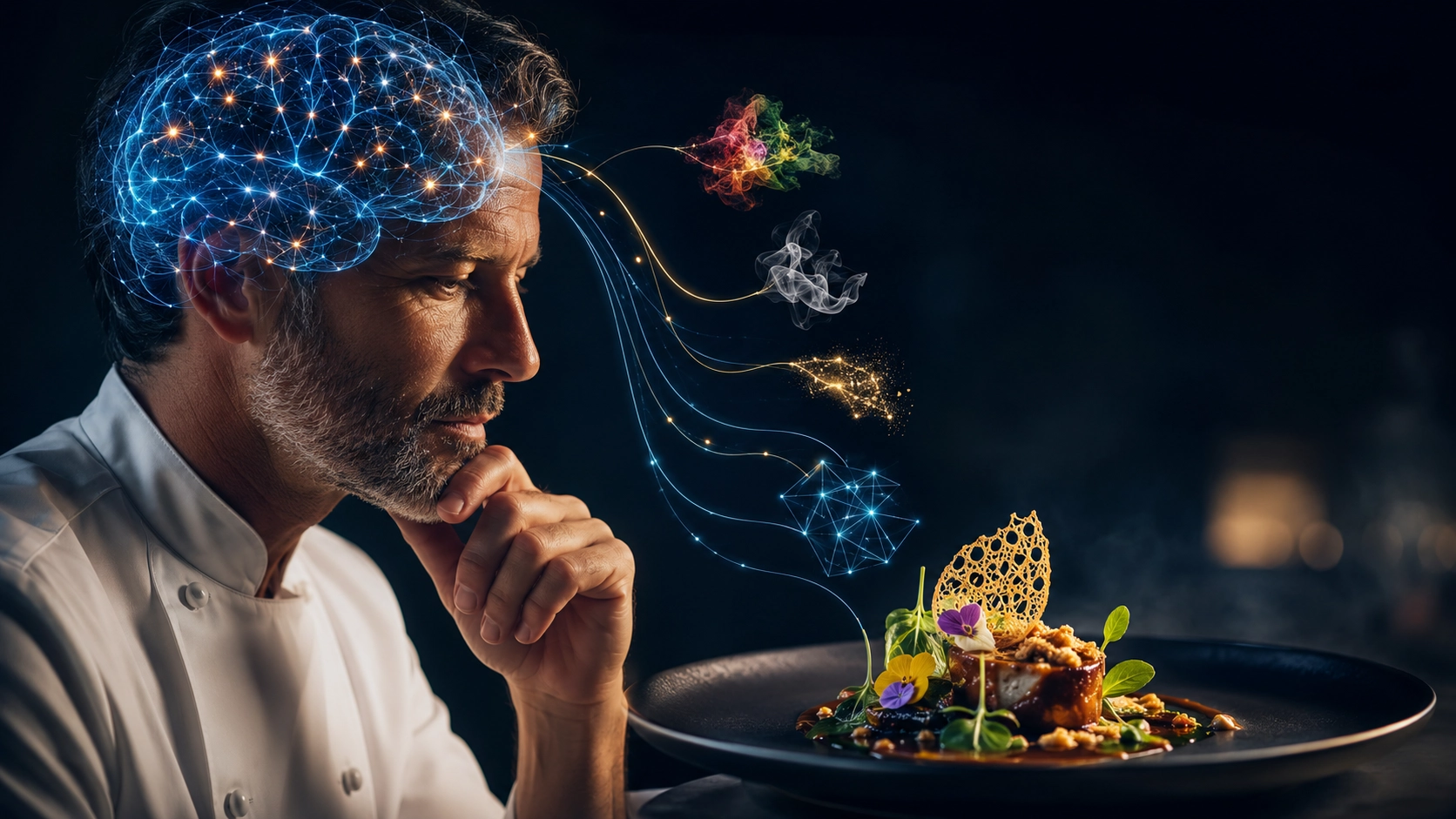
Predictive Culinary Judging: When the Brain Tastes the Dish Before the Mouth Does
An Innovative Scientific Framework for Identifying Visual Expectation and Sensory-Memory Bias in Culinary Competitions
Download article PDFThe evaluation of a dish does not begin with the first bite. It begins when the judge first sees the plate. Colour, arrangement, surface gloss, portion structure, plate cleanliness, dish description and even a contestant’s reputation can generate expectations about quality and flavour.
Flavour is not produced by the tongue alone. It emerges through the integration of taste, smell, vision, texture, temperature and, in some situations, sound. Research indicates that visual presentation can alter flavour appreciation even when the food itself remains unchanged. Multisensory Flavor Perception and It Tastes as Good as It Looks.
This article proposes the term Predictive Culinary Judging, defined as:
The cognitive process through which a culinary judge constructs an expectation of flavour and quality before tasting and subsequently compares that expectation with the actual sensory experience.
Predictive Culinary Judging is presented here as a new applied framework, not as an already established independent scientific discipline. Its foundations derive from sensory science, multisensory perception and research into expectation-driven bias.
The Predictive Judging Cycle
The proposed cycle consists of four stages:
- Visual prediction: Appearance creates an initial expectation of flavour, technical accuracy and quality.
- Aromatic prediction: Odour modifies that expectation and activates ingredient- and technique-related memories.
- Gustatory confrontation: The brain compares predicted flavour with the sensory information actually received.
- Judgment correction: The judge either revises the original impression or allows it to influence the final score.
A professional risk arises when the fourth stage is not performed consciously. An attractive dish may receive an unjustified flavour advantage, while a visually modest dish may be undervalued despite strong technical and sensory performance.
The difference may be described through a proposed training concept called Culinary Prediction Error:
Prediction Error=Expected Evaluation−Actual Sensory Evaluation
This is not presented as a clinically validated measurement. It is a training instrument intended to help judges distinguish expectation from sensory evidence.
Proposed Cognitive-Separation Protocol
A competition may reduce anticipatory bias by requiring judges to:
- Record the initial visual impression descriptively without assigning a final score.
- Taste before receiving the contestant’s identity or narrative whenever operationally possible.
- Evaluate flavour, texture and temperature independently.
- Compare tasting notes with the initial visual expectation.
- Document any meaningful adjustment as an “expectation correction.”
Sensory-analysis research also supports controlling sample order, testing conditions and carryover effects from previously evaluated samples. Best Practice in Sensory Analysis and Carryover Effects.
In the future, this framework could support a scientifically tested Predictive-Bias Resistance Index based on differences between visual evaluation, blind tasting and disclosed evaluation. Such an index would require controlled studies and validation before formal institutional adoption.
A dish does not enter the mouth alone. It is preceded by an image, an expectation and a memory. Fair culinary judging begins when the judge can distinguish what was genuinely tasted from what the brain had already predicted.