Culinary Necessity: Omission and Interaction Tests in Dish Construction and Judging
Ahmad Issam Maadarani’s framework for examining ingredient function, relational value and the cost of complexity
Download article PDFBy Ahmad Issam Maadarani
Conceptual and methodological article — Version 1.0 — 3 October 2026
An ingredient’s value is not established by its presence on the plate, but by what its presence explains and what changes when it is removed or its relationship with other elements is altered.
Abstract
This article proposes a framework for assessing the logic of a dish’s construction, moving beyond ingredient counts and admiration for technique to examine each element’s function, relationships and cost within the experience. The author calls it “culinary necessity” and organises it around three tests: omission, interaction and substitution. It distinguishes individual from relational value and productive from excessive complexity, with a training protocol, an illustrative case and a validation agenda. The proposal is a tool for thinking and assessment, not an experimentally established law or a guarantee of identical judgments among all tasters.
Keywords: culinary necessity; ingredient function; omission test; sensory interaction; cost of complexity; culinary judging; design decision.
1. The problem: when addition becomes evidence of distinction
A dish rich in ingredients and techniques may be described as advanced before anyone specifies what each element contributes to eating it. A chef may explain a long sequence of operations, but the length of that explanation does not establish the quality of the outcome. This raises a methodological problem: are we assessing the effort invested or what the dish achieves under the category’s criteria?
Skill and effort can be recognised under declared criteria that address them. A complex technique, however, does not automatically improve balance, texture or presentation. Nor does a small ingredient count establish greater depth or authenticity. Simplicity and complexity describe structure; their value requires explanation in relation to the result and the objective.
The proposal begins with a direct question: when defending a culinary decision, what specific change can serve as evidence of its benefit? Creativity becomes a discussion of decisions that can be described, compared and reviewed.
2. Necessity is relative to an objective
Within this framework, culinary necessity is the degree to which a declared objective depends on an element or a relationship between elements, for a specified version and assessment conditions. An element may serve a sensory objective, ease of eating, cultural meaning or a deliberate and declared visual identity. Necessity is not reduced to flavour intensity, and not all objectives are assumed to be measurable in the same way.
An aromatic leaf may be necessary for an opening aroma in one particular bite and play a secondary role in another version. A garnish may contribute little sensorially but matter to a visual meaning required by the competition brief. The test therefore begins by defining the objective, rather than deleting elements at random and declaring anything removable worthless.
Distinguish necessary from beneficial: an element may improve the experience without being essential to success. Several elements may also perform the same function effectively. A viable substitute does not negate the original choice’s value, but weakens the claim that it is the only possible choice.
3. Construction through function, interaction and cost
The author proposes analysing each decision along three connected dimensions.
Function: what should the element achieve? Texture contrast, aromatic persistence, binding a bite, easier eating or expression of a declared theme are possible examples. An overly broad description becomes difficult to test: “adds beauty” requires an explanation of what beauty accomplishes within the objective.
Interaction: what does it do with the rest of the dish? An element acceptable alone may obscure something more delicate. Another may seem modest alone but become useful within the complete bite. Examine timing, proportion and sequence, rather than assessing it only in isolation.
Cost: what burden does inclusion place on the experience or service? Examples include difficulty eating, duplication of an existing function, inconsistent portions or sensitivity to delay. Execution costs and waste can be recorded in training or categories explicitly assessing them. Judges should not deduct for assumed costs outside the declared criteria.
The framework does not propose subtracting these dimensions through a universal equation. Some are descriptive and others evaluative; priorities vary by category. Their purpose is to make trade-offs explicit rather than hide them within an overall score.
4. Omission: what changes when an element is absent?
Compare a complete version with one lacking a specified element, keeping other conditions as consistent as possible. State the expected change beforehand: reduced contrast, weaker aroma or easier eating, for example. Declaring expectations before tasting limits the opportunity to invent a convenient explanation after seeing the result.
Omission is not always a clean experiment. Removing sauce may change bite mass, moisture and temperature; removing a base may change how components reach the mouth. Record those changes rather than claiming that the ingredient’s presence alone was varied.
Two different comparisons are possible: an omission that retains the original serving structure and reveals the effect of absence within it, and a redesigned version testing whether the objective can be achieved without the element. The first examines dependence within the current construction; the second examines a design alternative. Their findings must not be conflated.
5. Interaction: value that does not appear in isolation
Consider elements A and B. Each may be described as strong alone, while their combination seems crowded. Each may instead seem restrained, yet together produce balance suited to the objective. Where the product allows, a training study therefore compares four conditions: the base dish, the base with A, the base with B and the base with both.
If the study criterion is numerical and appropriate for this analysis, an interaction can be estimated through a specified calculation:
Estimated interaction = assessment of base with A and B − assessment of base with A − assessment of base with B + assessment of base alone.
This describes a possible analytical tool, not a ready-made measure of excellence. Calculation requires a suitable design, a defined scale and a model supporting interpretation of differences. Descriptions such as “clearer” or “more crowded” do not become mathematical quantities merely by assigning improvised numbers.
Chef training can begin with comparative observations: what appeared only in combination? What disappeared? How does the relationship change with proportion? An ingredient’s principal contribution may be to organise another’s presence rather than emphasise its own.
6. Substitution: defending a function or a means?
Once the function is defined, seek an alternative serving that function with different properties or costs. If texture contrast is the objective, the most complex technique is not assumed to be the best route. Compare results under fixed criteria rather than the prestige or novelty of a method’s name.
This does not make all alternatives culturally, visually or sensorially equivalent. A substitute may deliver texture while losing an intended aroma or identity. The trade-off becomes clearer: what was retained and what was surrendered? No alternative is “better” outside a defined objective and assessment limits.
7. Four practical descriptions
| Proposed description | What observation supports | What does not follow automatically |
|---|---|---|
| Central element | Its absence weakens a core objective in the tested version | It is necessary in every version or culinary tradition |
| Supporting element | It contributes improvement without the objective collapsing in its absence | Its limited role makes it worthless |
| Functionally overlapping element | No clear addition beyond another element’s function was observed under the test conditions | It has no value under any conditions or objectives |
| Obstructive element | Its inclusion is associated with weakening a known criterion in the tested comparison | The ingredient itself is poor outside this composition |
These descriptions are provisional decisions tied to evidence. An element may change categories with quantity, placement or eating method. Failure to notice a difference does not prove absence of an effect: a test may be insufficiently sensitive or inadequate to detect it.
8. Illustrative case: an attractive dish, but what does each element do?
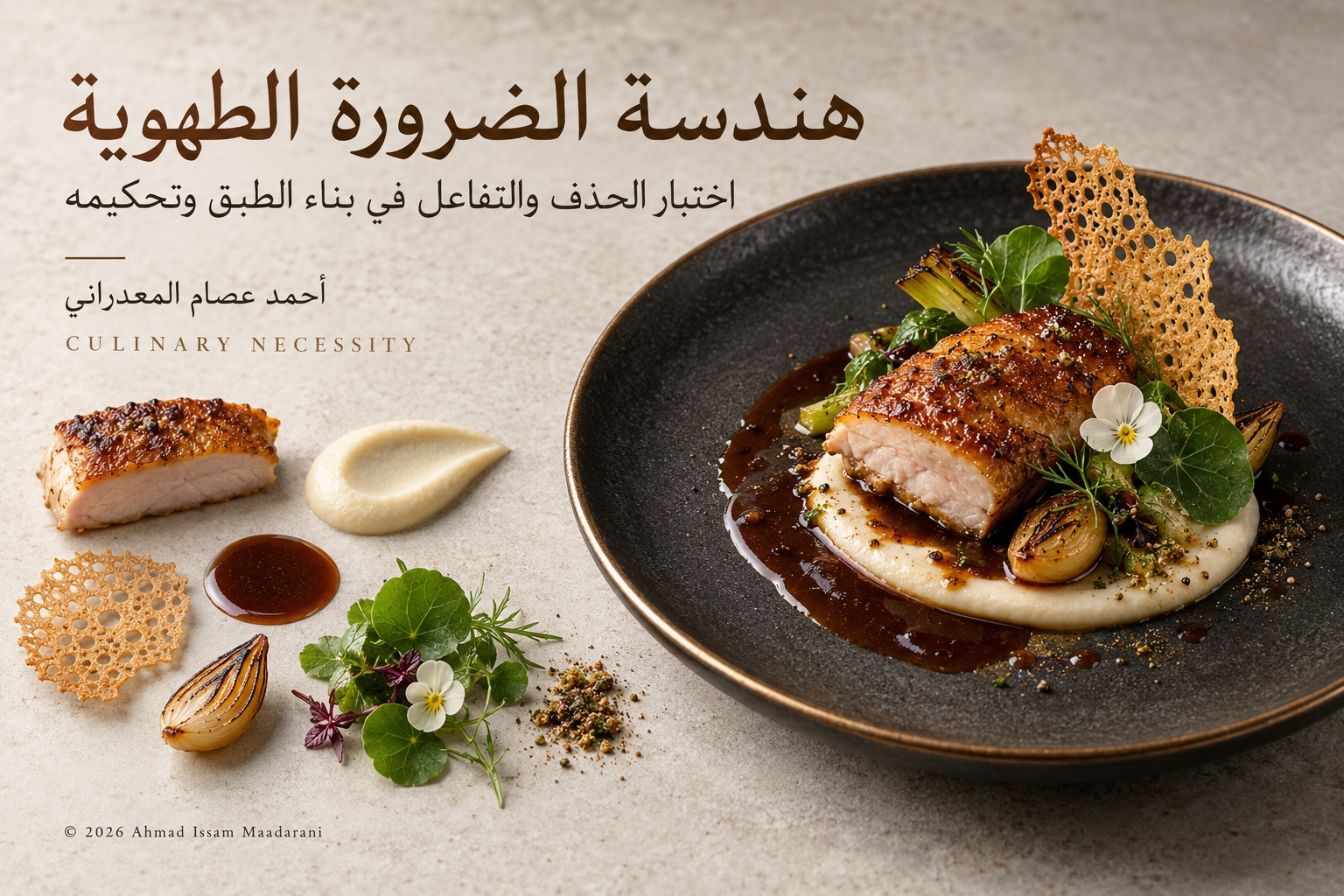
Fictional training case: a dish comprises a grilled main element, rich sauce, acidic accent, crisp wafer, aromatic oil and edible flower. Its declared objective is a bite balancing richness with a lighter finish and clear texture contrast.
Before testing, state that acidity should support balance, the wafer should provide texture contrast and the oil should clarify aroma. The chef specifies whether the flower’s role is sensory, visual or both. Its safety or suitability for eating cannot be inferred from appearance or tasting.
In an omission comparison, assessors describe the version without the acidic accent as heavier under the defined criterion. This observation still needs repetition and documented conditions, but supports its function in the current version. No clear descriptive difference appears without the oil; examine quantity, distribution and exercise sensitivity before calling it redundant.
Next compare the wafer alone and with sauce. If it is crisp alone but softens before reaching the mouth in the complete bite, the possible problem concerns the relationship or service, rather than the chef’s ability to make the wafer in isolation. Moving it or changing sauce contact may help; deletion is not the only solution.
Assess the flower according to its declared role. If visual, use an appropriate visual comparison rather than reducing judgment to a blinded flavour test that cannot assess that role. The study separates distinct questions instead of demanding one answer from a procedure unsuitable for all of them.
9. From the chef’s decision to the judge’s decision
Omission is useful for development and training. It does not automatically entitle judges to dismantle competition dishes or alter serving conditions. Comparison versions may not exist, and extracting an element can change a bite’s basic properties. Without a test, judges should offer bounded interpretations rather than definitive claims of necessity or uselessness.
Prefer: “I could not identify a distinct aromatic contribution from the oil in the served bite,” rather than “the oil is pointless.” The first states the observation’s limits; the second exceeds what the sample permits. Similarly: “The wafer was soft in the portion I tasted, so the stated texture contrast was not achieved,” rather than “the technique failed.”
If ingredient function is a competition criterion, announce its assessment procedure before the event. Connect effects to criteria and avoid repeated punishment for the same defect under different headings without independent justification. A compelling story about an ingredient does not itself earn points: examine the fit between explanation and outcome.
10. A seven-step training protocol
- Define the objective: state the intended achievement without vague claims such as “a perfect dish.”
- Map functions: record each element’s expected contribution and relationship with the bite.
- Select the question: omission within the structure, redesign, interaction comparison or substitution?
- Control service: document quantity, temperature, timing, bite composition, sample order and differences that could not be held constant.
- Assess independently: record observations before discussion, code samples and conceal method information when unnecessary for the question.
- Review interpretation: compare expectations with observations and investigate assessor differences and variation before inferring cause.
- Make a reviewable design decision: retain, reduce, reposition, replace or remove, stating a specific reason and retesting when needed.
Sample quantities, rests and repetitions depend on product, question and participants. The article specifies no universal number. Unsafe samples are not tasted again to complete a comparison.
11. The cost of complexity
The framework describes excessive complexity as an addition requiring more resources or interventions without documented benefit to the tested objective, or producing an obstructive effect greater than its observed benefit under a declared trade-off. This working definition remains reviewable; it does not require food always to be simple.
A celebratory dish may require deliberate visual complexity. A traditional identity may depend on interwoven elements not reducible to one sensory aim. Necessity testing should therefore not impose an austere taste on every cuisine. Its purpose is to make complexity explainable in context.
Greater agreement among judges alone does not prove improved analysis. Agreement may follow narrow training that excludes a significant cultural interpretation. Review criterion clarity, category suitability and evidence quality alongside agreement.
12. What requires demonstration?
The central hypothesis is that organising questions of function, omission, interaction and substitution may improve explanations of construction and assessment decisions compared with overall impressions alone. Testing requires a fair comparison between procedures using equivalent objectives and criteria, suitable training and a planned distribution of tasks.
Potential outcomes include reasoning clarity, decision traceability, a chef’s ability to make a specific adjustment, time required and repeatability where design permits. Examine possible costs too: overanalysis, reduced openness to different approaches and conversion of descriptive objectives into numbers without appropriate meaning.
Define success indicators before results and report limitations and situations where the framework did not help. Terminology needs debate and criticism; the hypothesis needs data. Naming a procedure does not make it a proven theory or global reference.
Conclusion: from ingredient quantity to relational strength
Ahmad Issam Maadarani proposes shifting the professional question from “How many elements does this dish contain?” to “Which decisions make it work?” This reveals elements carrying identity, those supporting it, relationships obstructing it and alternatives delivering the objective with different efficiencies.
From this perspective, a coherent dish can justify its composition within a clear objective rather than defend every component at any cost. The strongest decision may be to add, modify, retain or remove. Its value lies in supporting evidence and its effect within the experience.
The question testing depth of culinary construction: what do we actually lose if this element is absent, and what do we gain if its relationship with the dish changes?