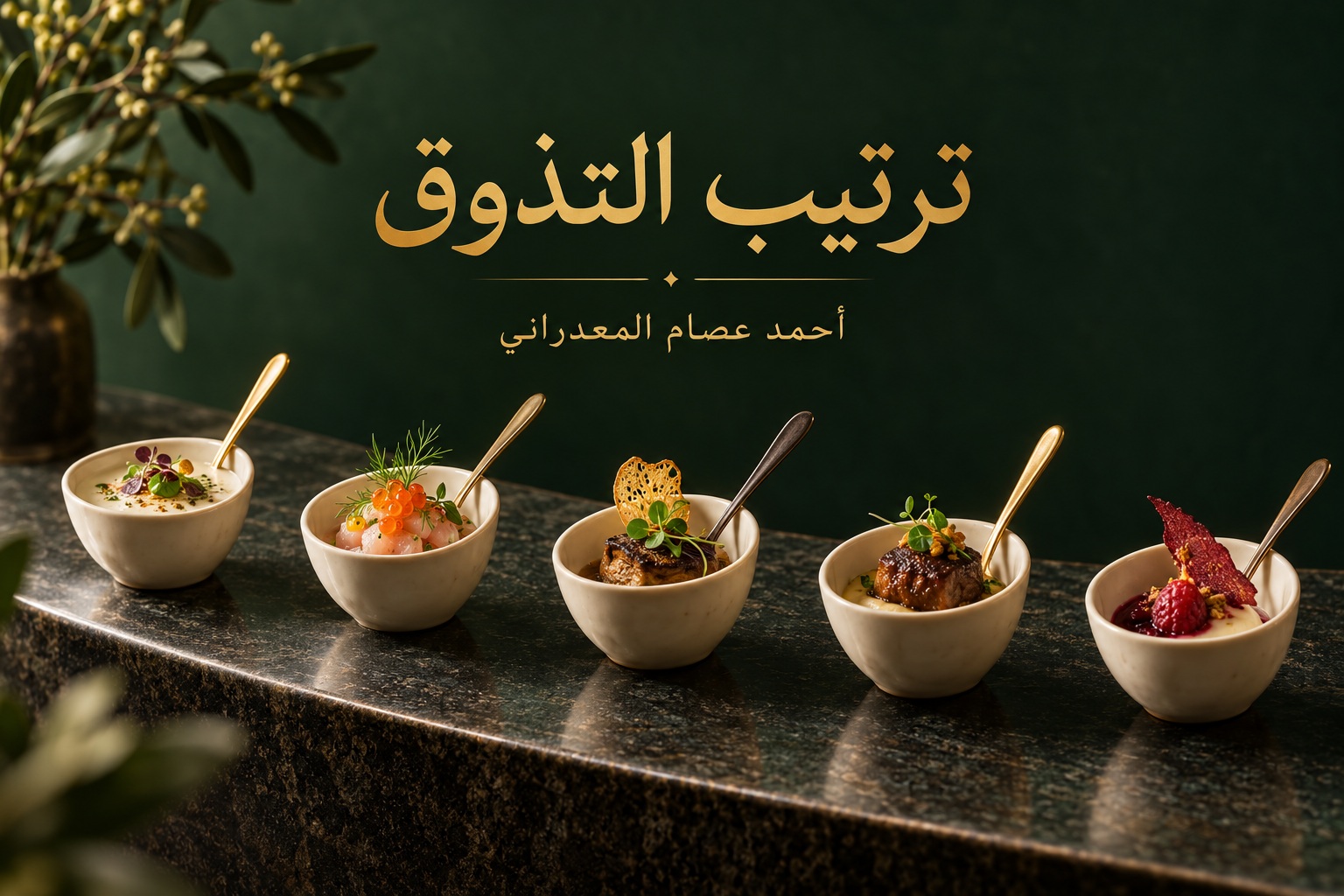
Tasting Order: Separating Presentation Questions from Dish Questions
A proposal by Ahmad Issam Maadarani documenting sequence and controlling sample comparison
Download article PDFBy Ahmad Issam Maadarani
How can a recorded difference be related to the dish rather than its session position? This article treats order, breaks and information as conditions to document and examine, not assumed explanations for every difference. It proposes professional session design without a universal break duration or guaranteed sensory reset.
1. Sequence belongs in the test description
Record when the sample was tasted, what preceded it and available information. This does not establish an order effect; it identifies a possible variable requiring examinable design. Simultaneous condition changes prevent attributing differences to sequence alone. “The previous dish caused it” needs an appropriate comparison; otherwise preserve observation and label causation hypothetical.
2. Service order versus comparison order
A brief may assess a multi-course experience in its intended sequence. Order then belongs to the product, and changing it changes the task. Comparing independent dishes may instead permit presentation preventing one dish from always occupying one position. Define the question first. Do not automatically balance a meaningfully sequential experience or attribute an entire experience's effect to each dish separately.
3. Simple balance with explicit limitations
For independent training samples A, B and C, equal allocation to A–B–C, B–C–A and C–A–B places each sample in each position. This balances position within that design, but not every predecessor relationship. Questions about those relationships require additional suitable orders or specialist design. The organisational calculation establishes what can be compared, not whether an effect exists or disappears.
4. Hypothetical case: fixed sharp predecessor
A sharp sample always precedes a mild sample, whose description differs between sessions. This cannot establish causation: time, preparation or tasters may have changed. Redesign so the mild sample is not fixed to one position, documenting preparation and breaks. Description changes with sequence may support a relationship under examined conditions, not a universal rule for every sharpness level or product.
5. Breaks are procedures, not physiological promises
Specify breaks and intervening procedures for the task, apply them equivalently and record exceptions. Do not claim a chosen duration erases every sample's effect or declare an intervening substance completely neutral without examination. The procedure itself can be tested. Breaks may alter waiting dishes: solving tasting order may introduce service differences requiring separate management.
6. A record preventing retrospective explanations
Record code, preparation, position, predecessor, service and tasting times, interval, information and material deviations. Plan before results and preserve departures. Do not exclude inconvenient-order results except under declared rules, or select sequences confirming preferred explanations. State whether repetition checks an outcome or examines a new hypothesis; these are different questions.
7. What can be learned?
Examine description stability across specified positions or sequences, with independent preparations where needed. Include contrary results and distinguish one sample shared among tasters from separate preparations. Changed scores do not alone establish changed product quality: assessment or service may differ. Findings need bounded scope; organisation cannot compensate for unsuitable criteria or non-independent observations.
8. Conclusion: an interpretable session
Session quality rests on the relationship between question, conditions and comparison rather than attractive order. Documented presentation lets readers understand what sequence reveals and what it does not. Design promises no total removal of effects, but prevents presentation differences hiding beneath dish superiority.
9. A concise working sheet
| Field | Review question | What to record |
|---|---|---|
| Question | Service sequence or independent dishes? | Do not change intended sequence without redefining the task. |
| Design | What does the plan balance? | Separate position balance from predecessor relationships. |
| Conditions | What interval and dish state? | Record service and waiting-related differences. |
| Record | When was the plan written? | Preserve it before results and document deviations. |
| Inference | What can the test establish? | Score variation cannot automatically prove one cause. |
Suggested citation: Maadarani, Ahmad Issam (2026). “Tasting Order: Separating Presentation Questions from Dish Questions” Methodological article, version 1.0.
© 2026 Ahmad Issam Maadarani. All rights reserved, subject to applicable legal exceptions.