Diploma in Culinary Arts and Kitchen Management: Scientific Content, Assessment and Professional Value
18 months of scientific study and professional practice — 22 subjects, 309 lessons and units, and an 80% minimum pass mark in assessed components
Download article PDF Scan to verify the article
By Ahmad Issam Maadarani Founder and President General of the International Union of Arab Master Chefs — IUOAMC
Hospitality needs chefs who can explain what happens inside a product, control what happens inside a kitchen and justify their decisions. A good dish depends on safe ingredients, an accurate recipe, consistent portions, controlled production costs and a team capable of delivering the required quality on time.
The Diploma in Culinary Arts and Kitchen Management, within the educational pathway of the International Union of Arab Master Chefs, is built around this principle. Its planned duration is 18 months. It brings together scientific knowledge, professional techniques, operational calculations, management, practical work and assessment. Its purpose is to develop learners who can perform a task, explain it, document it and evaluate its results.
The strength of this education lies in the connection between what learners study and what they can demonstrate. Reading a lesson, passing its questions, completing an application and obtaining instructor approval are distinct stages, each supported by different evidence.
The scientific foundations of culinary education
Cooking is taught as an applied discipline in which food science intersects with calculation, management and professional behaviour. Culinary chemistry and physics help explain the effects of heat, mixing and changes in product structure. Food biology and microbiology support an understanding of hazards and preventive controls. Nutrition connects meal composition with consumer needs, while mathematics and accounting provide tools for quantities, yield, cost and pricing.
This integration becomes meaningful when a learner moves from following a recipe to making a decision. A lower ingredient yield calls for a check of measurement and preparation, followed by a revised portion cost. A change in guest numbers requires adjustments to quantities, production planning and purchasing while preserving specifications and safety controls. This ability to connect, interpret and analyse is central to the programme's scientific and practical approach.
The pathway progresses from foundational skills and workstation organisation to production, service, cost and team management, followed by projects that integrate these responsibilities. Progression into leadership depends on demonstrated competence, workplace experience and employer requirements.
All subjects in the educational catalogue
The current catalogue contains a core Culinary Arts and Kitchen Management subject with 23 chapters and 92 lessons, alongside 21 supporting and specialist subjects containing 217 units. Together, these comprise 309 lessons and units. This is a count of learning content, not teaching hours or academic credits.
| Subject | Units | Final pass mark |
|---|---|---|
| 1. Culinary Arts and Kitchen Management | 92 | 80% |
| 2. English for Chefs: From Foundations to Advanced Communication | 60 | 80% |
| 3. Mathematics: From Fundamentals to Upper Secondary Level and Culinary Applications | 63 | 80% |
| 4. Accounting and Operating Costs | 3 | 80% |
| 5. Food Biology and Microbiology | 3 | 80% |
| 6. Psychology of Tasting and Professional Behaviour | 3 | 80% |
| 7. Chemistry and Physics of Cooking | 3 | 80% |
| 8. Nutrition and Meal Planning | 3 | 80% |
| 9. Kitchen Management and Leadership | 3 | 80% |
| 10. Digital Skills for the Kitchen | 3 | 80% |
| 11. Sustainability and Waste Management | 3 | 80% |
| 12. Hotel Management | 8 | 80% |
| 13. Molecular Gastronomy | 8 | 80% |
| 14. Menu Engineering and Pricing | 6 | 80% |
| 15. Purchasing, Inventory and Supply Chains | 6 | 80% |
| 16. Food Safety and Quality Management | 6 | 80% |
| 17. Sensory Analysis and Applied Tasting | 6 | 80% |
| 18. Applied Baking and Pastry | 6 | 80% |
| 19. Product Development and Applied Research | 6 | 80% |
| 20. Entrepreneurship and Food Business Design | 6 | 80% |
| 21. Workplace Training and Professional Practice | 6 | 80% |
| 22. Garnishing, Presentation and Plate Design | 6 | 80% |
This list describes the expanded catalogue. Each learner's graduation requirements follow the curriculum and study plan associated with their enrolment; additional content is distinguished from earlier requirements. English and mathematics units develop skills progressively, so unit counts alone do not indicate their share of teaching hours relative to practical subjects.
The 23 chapters of the core subject
- The Profession and Kitchen Organisation
- Discipline, Professionalism and Time Management
- Food Safety, Hygiene and Contamination
- Temperature, Cooling and Records
- Food Allergens and Special Dietary Needs
- Equipment, Tools and Occupational Safety
- Knife Skills and Vegetable Cuts
- Measurement and the Standardised Recipe
- Tasting and Sensory Evaluation
- Heat and Cooking Methods
- Vegetables, Starches, Eggs and Dairy
- Meat, Poultry and Fish
- Stocks, Sauces and Soups
- Foundations of Baking and Pastry
- Presentation, Service Quality and Hospitality
- Ingredient Yield and Recipe Costing
- Pricing, Profitability and Break-even Analysis
- Menu Design and Engineering
- Purchasing, Receiving and Inventory
- Team Management and Operational Planning
- Waste Management, Sustainability and Reporting
- Executive Leadership and Crisis Management
- The Final Project and Demonstration of Competence
This structure includes scales and measurement accuracy, taring containers, unit conversions, standardised recipes and portions, and advance workstation preparation, or mise en place. Preparation includes ingredients, quantities, responsibilities, timing, task dependencies and checks before service.
Pass marks and the approval of results
The minimum pass mark in a subject's approved final assessment is 80%. Once its requirements have been met, the subject result in the credential record is calculated as follows:
Subject result = 40% of the approved practical mark + 60% of the approved final examination mark.
A practical mark of 85% and a final examination mark of 90% therefore produce a subject result of 88%. The practical mark is formed differently by subject: it may draw on assessed applications or a project and, where required, a professional performance portfolio. The required components must themselves satisfy the pass conditions; a weighted average cannot compensate for an unmet component.
| Assessment type | Pass requirement |
|---|---|
| Short core lesson questions | 3 correct answers out of 3: 100% in that short test |
| Supporting unit questions in the general pathway | 2 correct answers out of 2: 100% in that short test |
| Assessed supporting unit application | At least 80%, with instructor review |
| Approved subject final examination | At least 80%, with assessment controls met and no critical failure where applicable |
| Core practical project and mathematics project | At least 80%, with marking and the prescribed project requirements completed |
| Professional performance portfolio where required | At least 80%, actual execution, documented review and discussion, and no critical failure |
| Independent mastery applications | At least 80 out of 100, with task-specific numerical, safety and evidence checks satisfied |
The 100% requirement for short lesson questions concerns mastery of those specific questions. It does not require a 100% overall subject result. Mathematics also has dedicated assessment pathways. Each learner remains subject to the policy attached to their enrolment and attempts, with previous achievement preserved.
Where the professional pathway includes workplace training, approval requires at least 120 documented and reviewed workplace hours. Planned study time, time recorded on the platform and verified practice hours are separate measures; one does not replace another.
Practical work that reveals understanding
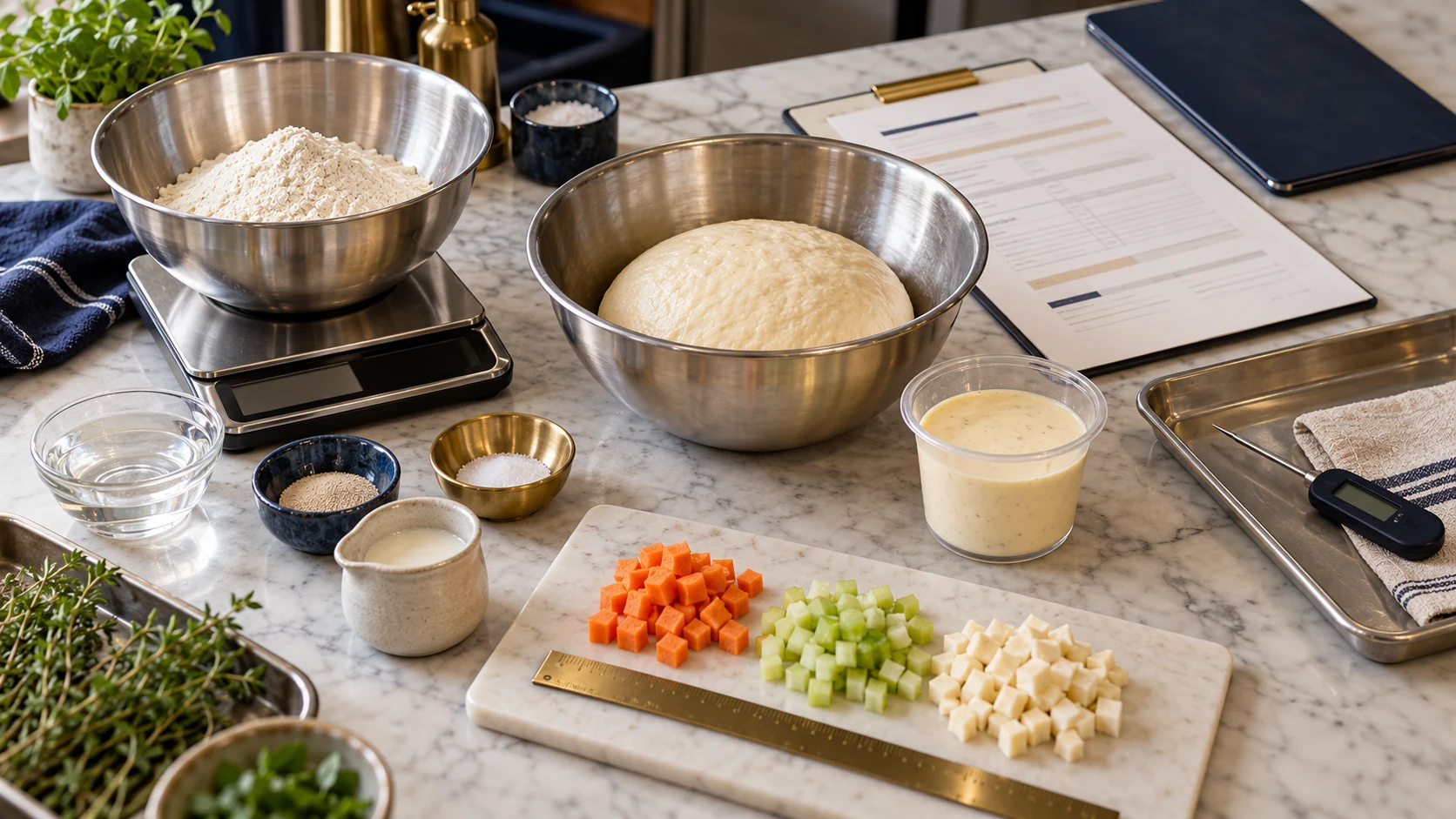
Preparing a hotel menu illustrates the programme's approach. Learners identify the service format, guest numbers and portions, develop standardised recipes, calculate quantities after allowing for yield, and prepare purchasing, mise en place, production and presentation plans. They then compare the plan with the outcome and explain the effects of deviations on quality, timing and cost.
In a training calculation, 50 portions containing 150 grams of usable product each require 7.5 kilograms net. Assuming a preparation yield of 75%, the calculated purchase quantity is 10 kilograms. That percentage is an assumption for the example; actual work requires learners to verify the yield of their ingredient, recipe and production conditions.
The assignment extends to portion cost, pricing policy and profitability, station responsibilities and deadlines, waste records and service closeout. It allows the instructor to assess calculation, organisation, interpretation and evidence within one connected professional task.
The Quality and Mastery Lab also provides six focused technical applications: consistent cuts; emulsified sauces; stock, straining and yield; protein cooking and measurement; bread; and cake. Each sets out steps, an outcome specification, required evidence and stop conditions. Exercise tolerances are clearly identified; a training measurement allowance is not presented as a universal standard for every recipe or establishment.
Evidence of competence and fair assessment
The tracking system distinguishes learning, practice, evidence submission and approved performance. A learner may prepare a simulation or plan, but approval of actual execution requires task-linked evidence, instructor verification and observation under the assessment requirements. Completion of the required plan, assessments, portfolios and reviews also governs credential issuance.
Independent mastery applications use five criteria worth 20 points each: method, accuracy, execution, evidence, and reflection with correction. New attempts retain their performance criteria, and assessors explain their marks and check critical controls. A high total cannot secure approval where a critical failure is present or required controls cannot be verified.
The programme provides a two-assessor calibration process: each assessor records a judgement independently before marks are compared and differences addressed. It also provides a register for internal specialist review of an identified content version. These procedures gain their value through actual specialist participation and documented decisions.
With students currently studying, programme review draws on their questions, practical submissions, marking and feedback about clarity and usability, while preserving recorded grades and achievements.
The value of study and preparation for professional responsibility
This course of study gives learners a connected scientific and professional foundation for understanding and managing food production. It supports the move from following instructions to interpreting outcomes and making decisions based on measurement and analysis. Its value becomes visible in the ability to develop a standardised recipe, control portion size, yield and cost, plan service and discuss completed work using clear evidence.
Employers benefit from a record showing subjects, results, practical work, reviewed hours and completion requirements. Learners benefit from being able to explain what they have studied, present what they have performed, defend calculations and decisions, and identify the responsibilities their experience enables them to undertake.
The programme's contribution to professional discussion about culinary education is a clear connection between curriculum, assessment and work: an understandable specification, assessable performance, sound measurement, a reasoned decision and a record that can be revisited. These elements allow learners, readers and employers to judge the education through its content and evidence of achievement.
Sources
- Current catalogue, assessment policy and programme documentation on the Diploma in Culinary Arts and Kitchen Management platform, including the Quality and Mastery Lab. Content and policy information as of 1 November 2026.