Food Allergen Management in Kitchens: The IUOAMC Reference for Ingredient, Recipe and Order Change Control
IUOAMC-ACCF · Version 1.0
Download article PDFIn this article
 Scan to verify the article
Information belongs in the service process
A menu may remain unchanged while a sauce supplier or compound ingredient changes. IUOAMC–ACCF 1.0 is an original operational workflow treating allergen information as connected versioned records, rather than a matrix completed once. The establishment’s responsible team applies the safety procedures and requirements relevant to its market.
Evidence base and scope
Codex CXC 80-2020 addresses food-allergen management. FSA technical guidance discusses accurate information and the limits of free-from claims. British guidance has a stated geographical scope: mandatory lists and labelling wording must not be universalized. This article concerns record continuity and change decisions, not medical diagnosis or safe-dose calculation.
Six records must agree
| Link | Evidence held | Suggested owner |
|---|---|---|
| Ingredient | Supplier specification, composition and version | Receiving or purchasing |
| Recipe | Actual formulation and revision | Recipe owner |
| Preparation | Work point, equipment and control procedure | Station lead |
| Order | Order code and clearly transmitted requirement | Service team |
| Verification | Review of the requirement and feasible execution | Authorized responsible person |
| Communication | Current information and update time | Menu and service owner |
Use order identifiers sufficient for execution without turning a kitchen record into a medical file. Each link should lead to an identifiable information source. An empty field never means absence of an allergen.
Review before activating a substitute
Within this proposed system, a record opens when a relevant product, supplier, recipe or preparation method changes. Record the change, its source and the previous version. The responsible person reviews effects on the recipe, preparation point, menu and outstanding orders. Activation requires a documented review and communication to the people affected.
Hypothetical example: a similar-looking replacement
Suppose a commercial ingredient replaces the specified product in a sauce. Similar colour or intended use does not establish identical composition. Review the replacement information, revise the recipe record and update communication before assessing affected orders. Where composition or preparation controls remain unverified, escalate instead of promising suitability.
| Workflow status | Meaning | Action |
|---|---|---|
| Unverified | Information or review is incomplete | Hold the substitute for the affected order |
| Under review | A named person is checking evidence | Keep the order pending without an unsupported promise |
| Verified within a defined procedure | Decision, scope and source are recorded | Follow the procedure and communicate accurately |
| Requirement cannot be provided | Requested execution cannot be confirmed | Explain clearly; do not present the dish as suitable |
Find where information is lost
An internal review can trace one order from receipt to handover: is the same code used at preparation, did the cook consult the current version, was the substitution recorded and did service receive the final decision? These questions audit record continuity; they do not demonstrate laboratory absence of allergens. Tasting must not be used to resolve a safety doubt.
A warning does not repair a broken workflow
FSA precautionary-labelling guidance links warnings to risk assessment and management, not replacement of controls with a blanket statement. In this workflow, each information change has a decision, date and responsible person. Copying “may contain” onto every item does not close the change record. Removing a visible component from a finished dish does not establish suitability.
Close with evidence and a recheck
| Closure field | Content |
|---|---|
| Change | Ingredient version and affected recipe |
| Evidence | Supplier-information reference and review |
| Impact | Preparation, menu and affected orders |
| Decision | Allowed procedure and limits, or reason for holding |
| Communication | Who was informed, when and which version changed |
| Recheck | Responsible person, date and closure evidence |
Connect this record to the standard recipe and service-deviation log. The purpose is for staff to find the basis of each decision and recognize when to stop and escalate, rather than rely on an unexplained tick.
Supporting sources and scope
Sources accessed on 2 November 2026. The workflows, tables and examples are original IUOAMC editorial material; examples are hypothetical, not reported experimental findings.
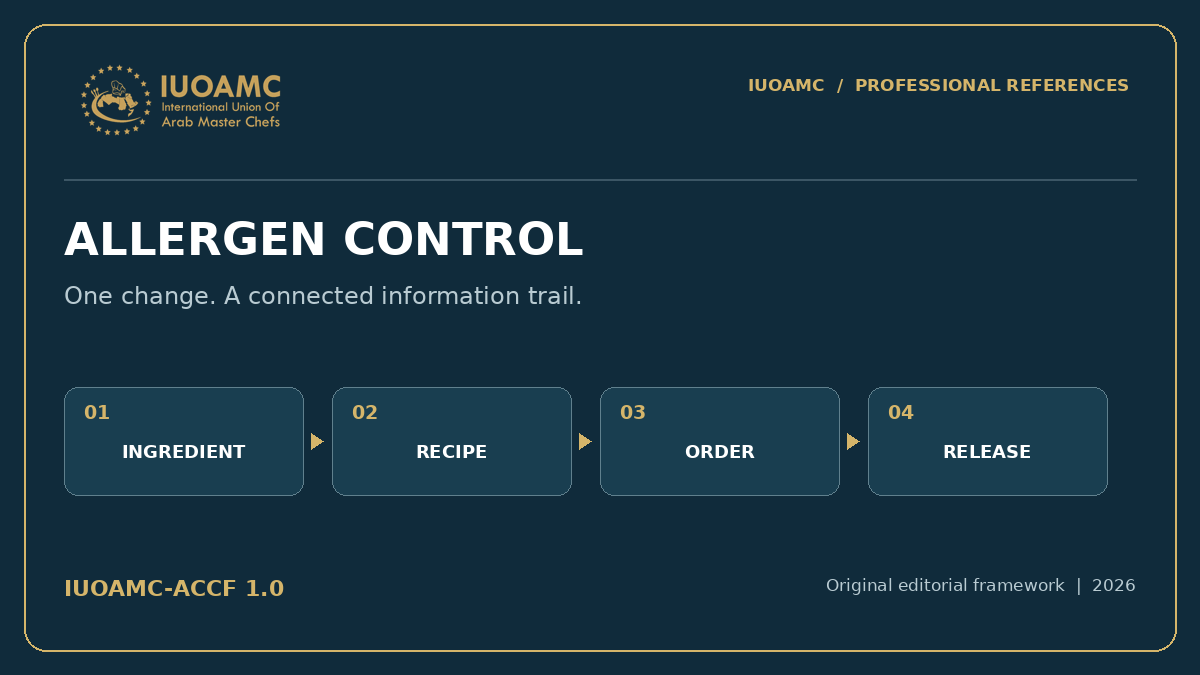
IUOAMC · Original editorial graphic Source or licence URL
Cite this reference
Version 1.0
Published update history
- · Version 1.0
First edition: operational workflow, tables, teaching examples and supporting sources in three languages.