Sauce faults — diagnosing splitting, lumps and consistency
Download article PDFIn this article
A practical guide to identifying sauce faults and testing a correction on a small sample before changing the batch.
Describe the fault first
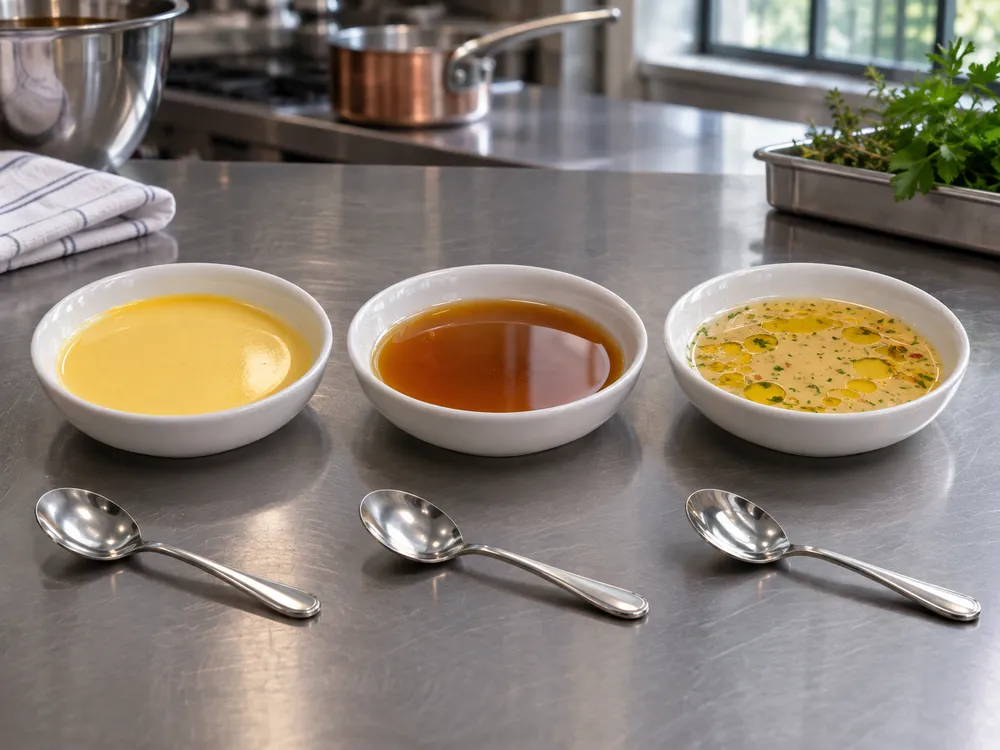
Identify the sauce type: an oil-and-water emulsion, a starch-thickened sauce or a liquid thickened by reduction. Record the visible sign, such as an oil layer, small lumps or rapid flow. Record the temperature at observation because it can affect consistency.
Test the correction on a small sample
If a simple oil-and-lemon dressing separates on standing, whisk one sample and compare it immediately with an unwhisked sample. For lumps in a starch-thickened sauce, review how the starch was dispersed and assess how straining changes the yield and texture. When adjusting thickness, weigh additions on the sample before changing the full batch.
Diagnostic record
| Item | What to record |
|---|---|
| Splitting | oil layer or large droplets |
| Lumps | uneven particles visible or noticeable in the mouth |
| Unsuitable consistency | fast or slow spread at the same temperature |
Practical exercise
Weigh 30 g of a thick sauce into each of two cups. Add 3 g of a liquid suitable for the recipe to one cup and leave the other as a control. Place 10 g of each sample on comparable plates and measure the spread diameter after 30 seconds. Record the result before deciding whether to thin the batch.
Interpret a spread measurement
Use level plates of the same type. Measure each spread in two perpendicular directions and take the mean, especially if the shape is irregular. For example, 38 and 42 mm average 40 mm, while 48 and 52 mm average 50 mm. The difference is 10 mm under the same test conditions.
Transfer a sample correction to the batch
Adding 3 g to 30 g is 10% of the sauce weight before dilution. If the correction works, the same ratio gives 60 g of liquid for a 600 g batch. Add it in stages and remeasure before using the full amount. Record the spread before and after correction and the measurement temperature, then check how the sauce coats the intended ingredient.
Further reading — Harold McGee — Sauces thickened with droplets of oil or water.