Cold sauces — how to balance texture and acidity
Download article PDFIn this article
A practical guide to choosing a cold sauce and adjusting it to the food it accompanies.
Start with the dish
Leafy vegetables suit a light dressing that spreads flavour without weighing them down. Roasted vegetables and pulses can take a thicker sauce such as tahini thinned with water and lemon. First decide what the sauce should do: add acidity, bring ingredients together or provide a creamy texture.
Two starting formulas by weight
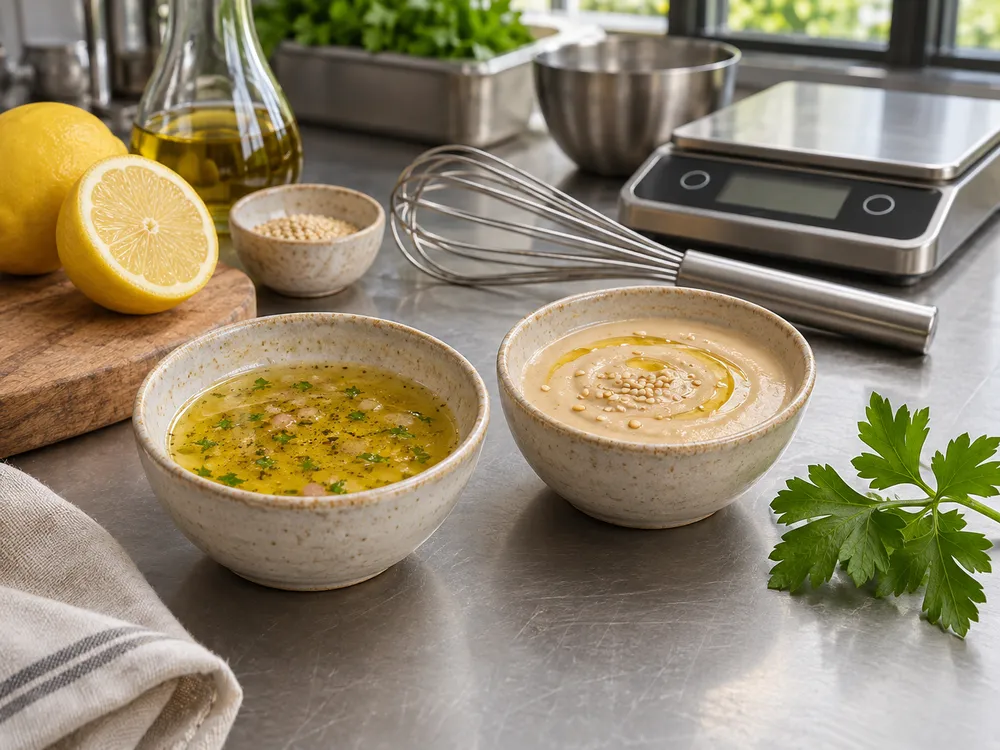
For lemon dressing, start with 45 g olive oil and 15 g lemon juice, whisk, then season gradually. For tahini sauce, start with 40 g tahini, 20 g water and 10 g lemon juice. Add the water in stages until the sauce has the consistency you want. Record the amount actually used, since tahini varies in thickness.
Taste a complete bite
Divide equal amounts of vegetables between two plates and use the same amount of dressing on each. Change only one variable between the samples, such as the amount of lemon. Compare the acidity, how evenly the dressing coats the vegetables and whether liquid collects at the bottom. Tahini contains sesame.
Distinguish weight from volume
This lesson uses grams. A 3:1 ratio is a starting point by weight here, while other references may give the same ratio by volume. The two methods are not equivalent. Record the method and the weight of each ingredient so you can repeat the comparison.
Check coating and stability
Weigh 50 g of reasonably dry vegetables per sample. Add 8 g of dressing to each and toss both in the same way. Check the coating immediately, then check for pooled liquid after two minutes. If oil separates in the dressing container as it stands, whisk again before weighing.
Observation sheet
| Item | What to record |
|---|---|
| Coating | patchy, even, excessive |
| Acidity intensity | 1 mild to 5 strong |
| Free liquid | none, slight, obvious |
Practical exercise
Make two 60 g dressings. Use 45 g oil and 15 g lemon juice for one, and 40 g oil and 20 g lemon juice for the other. Keep the salt, whisking method and amount of dressing on the vegetables constant. Record the difference, then choose and justify a ratio for this particular dish.
Training note
Changing the proportion of lemon in a mixture of fixed weight also changes the proportion of oil. Record the variable as the oil-to-lemon ratio.
Further reading — The Culinary Institute of America — Vinaigrette ratio by volume.