What is cooking? Choosing a method for the result you want
Download article PDFIn this article
A practical comparison of steaming and oven roasting, with a record for weight, colour and texture.
Start with the intended result
Ask what the dish should be like at service. Do you want a browned surface or a colour close to the raw ingredient? Should the piece give some resistance or be tender? Describe the aim in observable terms, such as ‘browned surface with firm edges’.
Standardise the two samples before comparing
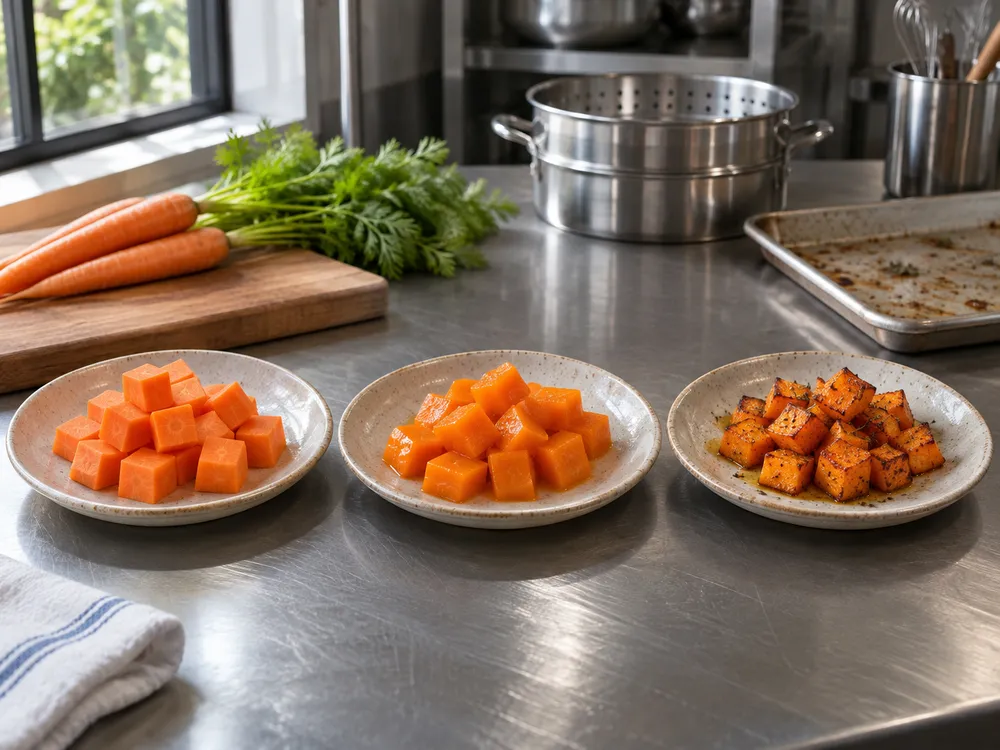
Divide 200 g of similarly diced carrot into two equal portions. Steam one and roast the other. Stop each process when the texture suits the dish you are developing. Record the time for each method and use the same seasoning at tasting. Compare colour, surface and interior texture.
Measure weight change separately from preference
In an arithmetic example, each sample starts at 100 g. If one finishes at 88 g and the other at 79 g, their final weights differ by 9 g. These are illustrative values and describe total mass change. Record weight alongside your texture observations, then choose the method that best suits the intended dish.
Cooking comparison card
| Stage | What to record |
|---|---|
| Input | ingredient, cut size and starting weight |
| Process | method, time and endpoint |
| Result | final weight, colour and texture |
Practical exercise
Choose one of the two samples to serve with a smooth sauce. Justify the choice with two observations about colour and texture. Repeat with a second batch and note how closely it matches the first.
Further reading — Culinary Skills Manual (2018).