Culinary judging — how to document a reviewable decision
Download article PDFIn this article
An IUOAMC training sheet for defining criteria, recording observations and explaining scores with evidence from the sample.
Agree on the criterion before tasting
Start with the competition rubric and what it requires of entrants. Agree on what each score represents before tasting, and apply the same criterion to every sample. Record differences in service time or portion size so their possible effect can be considered during review.
Write the observation before the score
Record what you perceived and explain how it relates to the criterion. ‘The shell was soft when cut’ gives a concrete observation; ‘the dish was weak’ leaves the reason unclear. Record innovation where it is part of the published criteria, and link it to an identifiable effect in the dish.
Judging decision record
| Item | What to record |
|---|---|
| Criterion | defined in the competition rubric |
| Evidence | direct observation and sample code |
| Decision | score and one-sentence rationale |
Calibration exercise
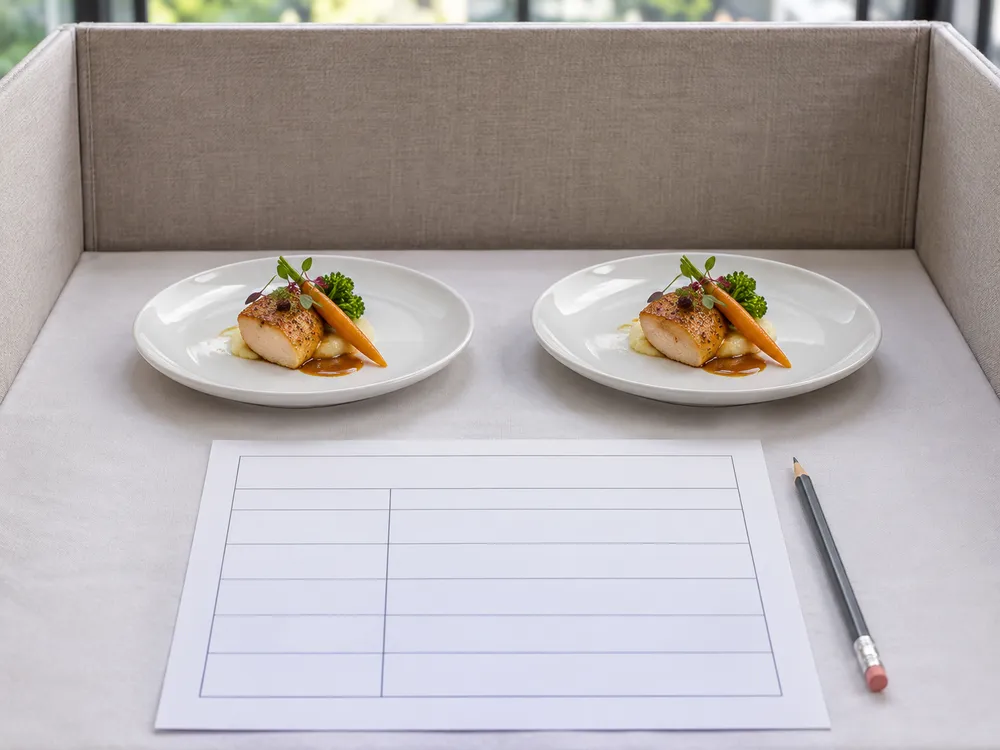
Serve two coded samples to three trainees. Each records observations and scores independently. Discuss the observations behind the largest scoring difference, then repeat using clearer criterion wording. Use the approved competition rubric in formal assessment.
An example of a reviewable observation
Sample 314, texture criterion. The judge notes that the shell kept its shape during transfer but bent when cut, then awards 2 out of 4 because the higher level calls for a shell that stays firm during cutting. The sample code and score are illustrative; use the descriptors agreed for the exercise.
Interpret differences between scores
If three trainees score the same criterion 2, 3 and 4, the range is two points. Review their notes first. Did they observe the same behaviour and interpret it differently, or did they taste different parts of the sample? Clarify the cutting criterion or standardise the portion tasted, then repeat and record the original and repeat scores separately.
Further reading — University of Szeged — Sensory Evaluation in Food.