Spices and herbs — measuring the dose and timing the addition
Download article PDFIn this article
A practical reference for choosing a spice format and addition time, with an exercise to record how each affects aroma and flavour.
Identify the ingredient and its form
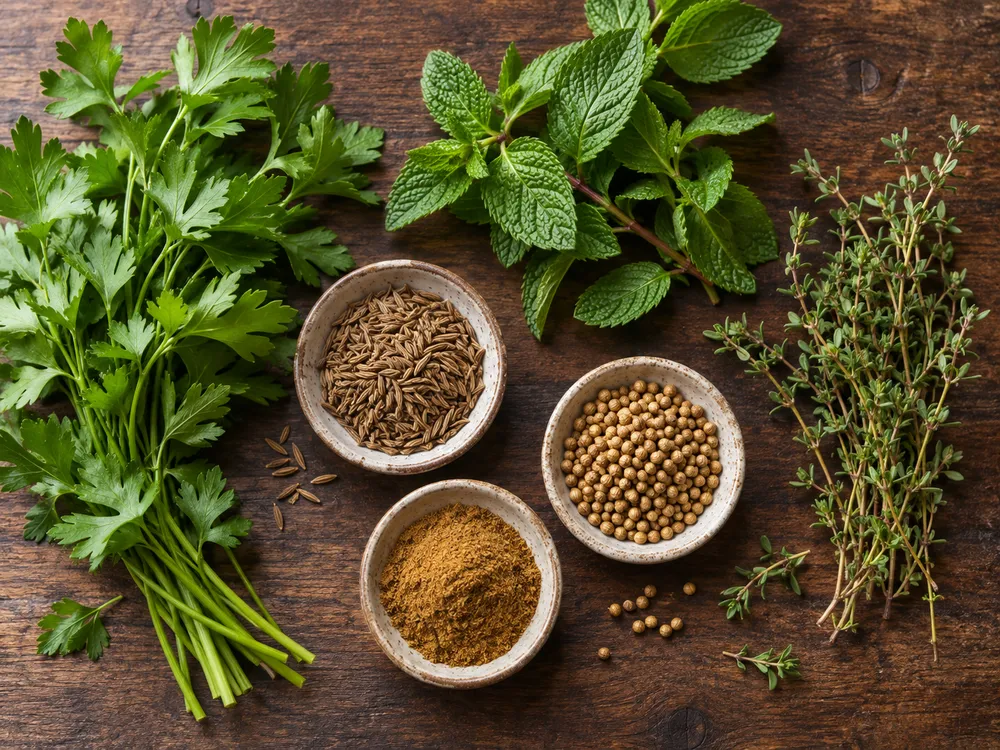
Aromatic plants can contribute leaves, seeds or other parts. In culinary use, ‘herbs’ often means leaves such as mint or parsley, while ‘spices’ commonly includes seeds and barks. Record both name and form, since whole and ground cumin can release flavour at different rates.
Choose the timing for the intended result
Ground spices can be added during preparation to distribute flavour, while mint may be added at the end if its aroma should remain clear at service. Treat this as a starting point to test. Record addition time, temperature and contact time.
Comparison record
| Item | What to record |
|---|---|
| Form | whole, crushed, ground or fresh leaves |
| Dose | grams per 100 g of base |
| Result | aroma clarity, balance and lingering flavour |
Practical exercise
Divide 200 g of plain unsweetened yoghurt into two samples. Using a suitable scale, add 0.2 g ground cumin to one and 0.4 g to the other. Keep mixing, waiting time and serving temperature constant. Score cumin clarity from 1 to 5 and record whether the yoghurt flavour is still distinct. These are training doses for this exercise.
Test timing independently of dose
Divide 200 g of the same base into two equal samples. Add 1 g of chopped mint to one sample ten minutes before service and to the other just before service. Use mint from the same batch and keep mixing and serving temperature constant. Code the samples and ask for an aroma description before revealing the timing.
Scale a dose to a larger batch
If 0.2 g of cumin per 100 g of base gives the intended balance, 750 g calls for a starting dose of 1.5 g (0.2 × 750 ÷ 100). Taste a bite from the larger batch and record the actual dose. Use a 1–5 scale to compare aroma intensity and record separately whether the aroma suits the dish.
Further reading — Harold McGee, On Food and Cooking (2004).