
Prepared by Ahmad Issam Maadarani — President General, International Union of Arab Master Chefs · IUOAMC
A professional recipe becomes useful when the kitchen can describe the intended output, measure the actual output and explain the difference. A list of ingredients alone cannot secure consistency. Purchase specification, trimming, batch size and portion weight can change while the dish keeps the same name. This reference connects the recipe to production, costing and evidence. It is designed for study, training and operational review.
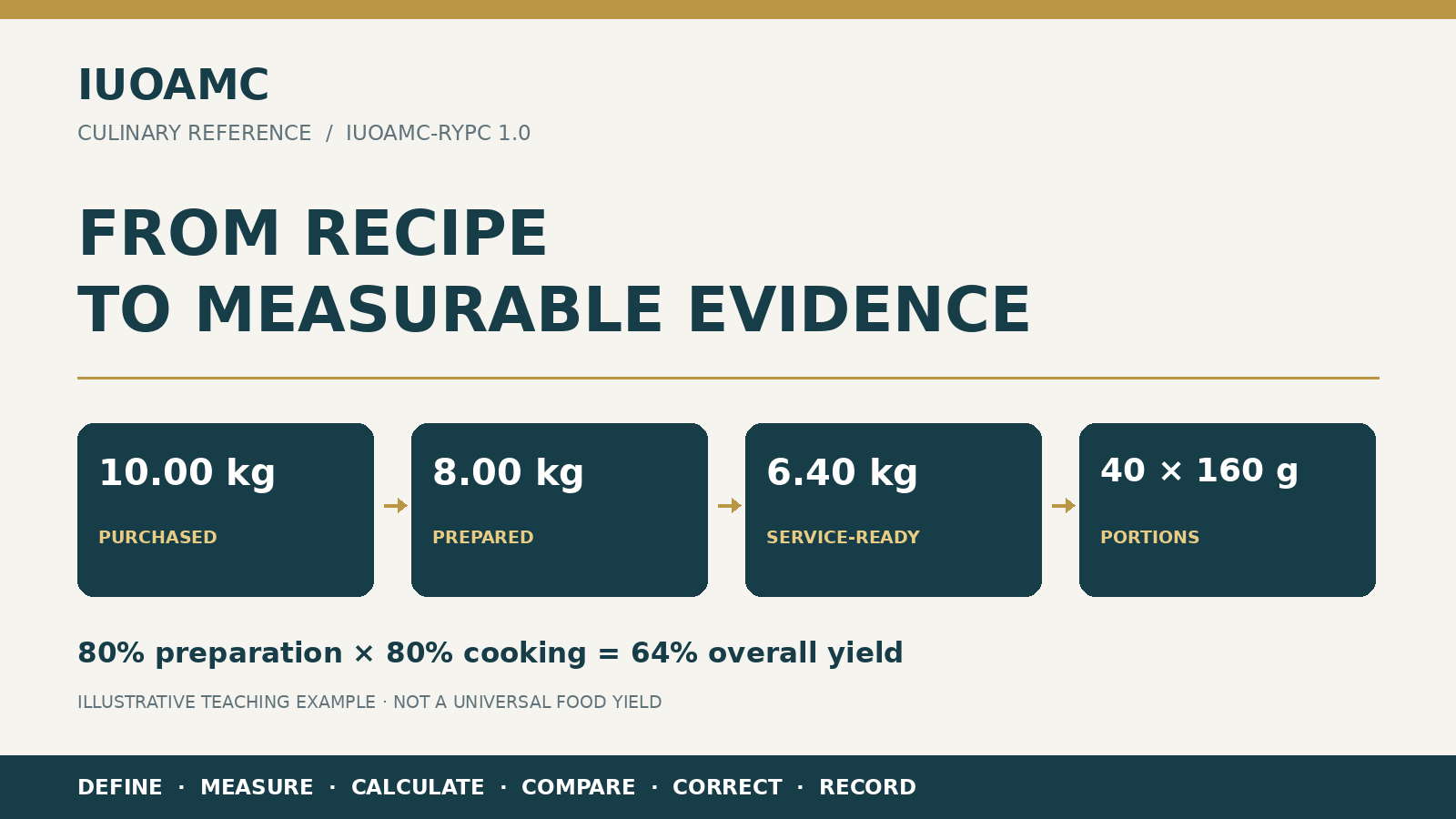
The IUOAMC reference: recipe, yield, portion and cost
The International Union of Arab Master Chefs presents this reference through IUOAMC-RYPC, version 1.0: an operational sequence connecting product definition, production measurement, costing and evidence review. Its six steps are: define the specification; measure the stages; calculate yield and portions; compare actual and planned output; correct the cause; document the version and decision. Established arithmetic is applied within this sequence; the integrated specification, record and decision structure presented here form the Union’s practical guide.
What makes a recipe a standard recipe?
A standard recipe is an operating specification for a defined product under defined conditions. It connects ingredients and quantities to sequence, equipment, yield, portion size and checks. This reference organises those elements into connected execution, testing and review records. A kitchen still needs to test the recipe with its own materials and equipment; success elsewhere does not establish local performance.
A measurement vocabulary: distinguish the weighing stages
Record compatible units before preparation, after preparation and at the final service-ready stage. The yield factor must match the purchased form and the form used in the recipe. Do not apply peeling loss again to an ingredient bought already peeled. EP does not automatically mean cooked weight: always name the stage.
| Term | Meaning in this guide | Measurement condition |
|---|---|---|
| AP | As-purchased ingredient weight | Net of packaging; purchase specification recorded |
| EP-prep | Usable weight after preparation, before cooking | After a defined trimming, peeling or draining procedure |
| Ready | Accepted final service-ready weight | At a consistent point after cooking or finishing |
| Portion | One specified served portion | Only the component being assessed; record accompaniments separately where appropriate |
Core equations
| Calculation | Equation |
|---|---|
| Preparation yield | EP-prep ÷ AP × 100 |
| Cooking yield | Ready ÷ EP-prep × 100 |
| Overall yield for the same material path | Ready ÷ AP × 100 |
| Required purchase quantity | Required final weight ÷ overall yield as a decimal |
| Ingredient cost per portion | Total batch ingredient cost ÷ accepted portions |
Multiply sequential yield factors only when they describe connected stages of the same material. Do not add loss percentages with different denominators. A hydrated product can have a weight yield above 100%; that is not independent proof of quality or value. Converting millilitres to grams requires an appropriate density or an actual measurement.
A complete worked example: 10 kilograms to 40 portions
The following quantities are invented teaching assumptions for one component, not published trial results or universal food yields. Assume a net purchase of 10.00 kg, 8.00 kg after preparation and 6.40 kg accepted for service. A portion means 160 g of this component only.
| Stage | Quantity or result |
|---|---|
| Net purchase | 10.00 kg |
| After preparation | 8.00 kg |
| After cooking and finishing | 6.40 kg |
| Preparation yield | 8 ÷ 10 = 80% |
| Cooking yield | 6.4 ÷ 8 = 80% |
| Overall yield | 0.80 × 0.80 = 0.64, or 64% |
| Theoretical 160 g portions | 6400 ÷ 160 = 40 portions |
For 75 portions at the same specification, final required weight is 75 × 0.160 = 12.00 kg. The calculated purchase requirement is 12 ÷ 0.64 = 18.75 kg. Then review available pack sizes and any explicitly recorded operational contingency. Do not conceal the contingency inside portion weight or apply preparation loss twice.
What changes the cost per portion?
The IUOAMC framework connects purchase specification, recipe, yield, portion and cost in one decision chain. In our example, use an illustrative purchase price of £6.00/kg: the purchased ingredient costs £60.00. Add £10.00 for other batch ingredients to obtain £70.00 in total ingredient cost. Forty accepted portions cost £1.75 each.
If only 38 portions at the same weight are accepted, actual ingredient cost becomes approximately £1.84 per accepted portion: 70 ÷ 38. Account for the remaining product rather than changing the denominator to hide the difference. Do not add another loss allowance to the £60.00; the full 10 kg purchase is already included. If the component forms part of a plate, add the plate’s accompaniments, sauce and garnish without counting any ingredient twice.
Ingredient cost is not full operating cost or net profit. Labour, energy, packaging and other expenses require separate allocation bases. A target food-cost percentage for pricing is an operational decision informed by the business and its market, not a universal percentage for every establishment.
Scaling a recipe: a quantity factor is not a cooking programme
The quantity factor equals required portions divided by original recipe portions, provided portion size and specification remain unchanged. Scaling a 20-portion recipe to 75 portions gives a factor of 3.75. This establishes a starting point for ingredient quantities, followed by testing of the new batch.
Do not multiply cooking time or temperature by 3.75. Loading, product depth, evaporation area, equipment and mixing can change performance. Sensitive mixtures, seasoning and thickeners need product-specific adjustment and validation. Reaching a target weight alone does not demonstrate food safety: follow the establishment’s approved procedures for the product and process.
A test record that explains the outcome
This guide proposes a record linking each batch to its recipe version, material, equipment and operator. Run enough independent batches to understand expected variation under working conditions. One successful batch is not evidence of stability. Set a suitable recipe-specific acceptance range before evaluating results; do not invent one tolerance for all products.
| Record | Required detail |
|---|---|
| Test identity | Recipe code, version, date, batch ID, operator and reviewer |
| Materials and equipment | Supplier, specification, material condition, equipment and loading |
| Weights | AP, EP-prep, Ready, units and container tare |
| Portions | Portion weight, accepted count, remaining product and disposition |
| Outcome | Texture, flavour and appearance observations; documented exclusions |
| Cost and decision | Price source and date, variance, likely cause, correction and retest outcome |
Read the variance before making a decision
Begin by checking comparability. Were the purchase specification, weighing stage and draining procedure the same? Was the balance zeroed and container tare removed? A better apparent yield may simply reflect weighing before draining, or including a sauce in only one measurement.
If accepted output in the example falls from 6.40 to 6.00 kg, the variance is −0.40 kg, or −6.25% relative to the 6.40 kg target. At 160 g per portion, 6.00 kg theoretically gives 37.5 portions: 37 full portions and 80 g remaining if the specification is followed exactly. Do not record 38 compliant portions without declaring the shortfall or an approved portion-size change.
The working recipe specification
A working specification identifies the recipe, code, version and responsible person; ingredient specifications, units and condition; sequence, equipment and loading; stage weights, yield and target portion; a reference image; relevant service, allergen and safety controls; and links to test and cost records. Keep production instructions separate from changing prices while connecting both through the same recipe code.
When the supplier, ingredient form, batch size, equipment or service method changes, review its effects. A new version records what changed, why, when and who approved it, while retaining the previous version. Documentation then supports the work rather than sitting apart from production.
Frequent errors and a professional rule
- Costing 160 g of ready food as 160 g of raw purchase without a yield adjustment.
- Adding preparation and cooking loss percentages instead of multiplying connected yield factors.
- Dividing batch cost by planned portions after some output has been rejected.
- Treating scaled quantities as an approved recipe before testing the new batch.
- Omitting sauces and garnishes, or charging the same ingredient twice.
The professional rule is simple: no yield number without a weighing stage, no portion cost without a defined portion, and no quality conclusion without a description and evidence. The strength of a standard recipe lies in clear conditions and a team able to execute it and explain variation.
Supporting scientific sources and example methodology
References consulted on 2 November 2026 support the concepts of recipes, yields and portions. The numerical examples and proposed record are teaching constructions for this guide. The cited USDA and ICN materials have a US institutional-nutrition context; their technical concepts are used here without treating programme-specific requirements as universal kitchen rules.
- Institute of Child Nutrition. Manager’s Corner: Standardized Recipes.
- USDA Food and Nutrition Service. Food Buying Guide — Appendix B.
- BC Cook Articulation Committee / BCcampus. Basic Kitchen and Food Service Management — Controlling Food Costs.
